
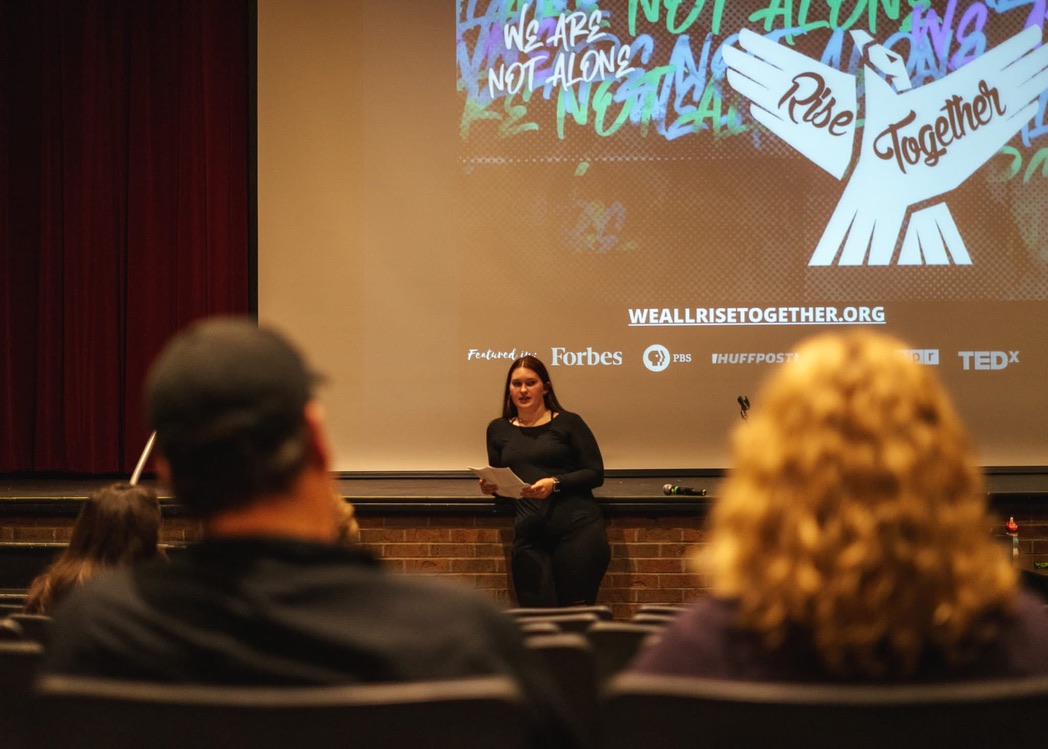
Tomorrow, we will be in Janesville with students. We have been talking with partners there for several years, and this visit has been a long time coming. Janesville also means a lot to me personally. I have family here, and it is a gift to finally bring our work to a community I care so much about.
On Wednesday, November 18, Anthony and I will spend the day with students at Franklin Middle School and a local charter school, in partnership with the Janesville School District and Janesville Mobilizing 4 Change / the Rock County Prevention Network. We are not coming to lecture. We are coming to tell the truth about our lives, make room for young people to feel less alone, and help schools keep the conversation going after we leave.
Why storytelling still belongs in school
For 13 years, RISE TOGETHER has been walking into gyms, auditoriums, and classrooms with a simple belief: when young people hear honest stories, they are more likely to feel connected, ask for help, and support their friends. Since 2013, that work has reached 500,000+ youth.
A school assembly is only an hour, but an hour can change what a student is willing to say out loud. Our school programming uses personal storytelling to talk about mental wellness, substance use, recovery, and belonging. After the presentation, we leave writing prompts and reflection activities, and we use pre- and post-presentation surveys to keep learning from students.
Public health research has long told us why connection matters. The Centers for Disease Control and Prevention describes school connectedness- the sense that adults and peers at school care about you as a person and about your learning- as a protective factor. Young people who feel connected at school are less likely to experience substance use and poor mental health. That is why we treat a school visit as the start of connection, not a one-time performance.
What the research shows
Our work has been studied carefully. In 2025, a peer-reviewed paper in Addiction Science & Clinical Practice evaluated our school speaking program with researchers at Penn State College of Medicine. Anthony Alvarado, our co-founder, is a research collaborator and a co-author of the study. The paper analyzed anonymous surveys from 10,438 middle and high school students who attended a RISE program between 2014 and 2020 across 240 schools in Wisconsin and nearby states.
Among the 996 students who rated the program’s impact, 71.3% viewed it favorably. 76.3% said the presenters’ personal recovery stories were the most valuable part. And 51.2% said they felt less likely, or much less likely, to use alcohol or drugs afterward. That response was stronger among middle school students, at 60.3%, than among high school students, at 49.5%. In nearly 2,900 written comments, students talked about wanting to avoid substance use, ask for help, support their peers, and think differently about recovery.
We are careful about what those findings mean. They come from students’ own reports after the program. They show receptivity and immediate intention, not long-term behavior.
We keep asking those questions. In an October 2025 post-presentation survey, 416 students responded after a RISE program. Ninety percent said they felt confident supporting friends or loved ones. Seventy-five percent said they felt able to find resources for help, and 64% said they felt confident using their own voice for positive change. These, too, are post-event self-reports, not long-term outcomes, but they tell us students leave asking what they can do next.
Join us tomorrow night
During the school day, we will be with students. In the evening, we want families and neighbors in the same conversation.
Parents, caregivers, educators, and community members are invited to a free presentation at the Franklin Middle School Auditorium, 450 N. Crosby Avenue, Janesville, Wisconsin, on Wednesday, November 18, 2026. Doors open at 6:00 p.m., and resource tables will be available then. The presentation begins at 6:30 p.m. Admission is free.
Xandi Finn, director of Janesville Mobilizing 4 Change and the Rock County Prevention Network, has invited NAMI, Crisis and Connections, and school mental health staff to table resources for families. Come a little early, say hello, and pick up what you need.
As Xandi shared in our press release, “Janesville School District is honored to bring this peer-led prevention programming to our students, staff, and community. We hope to help break the silence and not just raise awareness, but also take action.”
If you can be there, we would love to see you. This day has been years in the making. It is a chance to keep doing what the research and the students keep pointing us toward: tell the truth, build connection, and help young people know they do not have to carry things alone.
Learn more at weallrisetogether.org.
